Applied Consciousness
Beyond the Hard Problem Toward Human Transformation

There is a quiet shift beginning to take place in the study of consciousness.
For decades, the dominant question has been:
What is consciousness, and how does the brain produce it?
It is a compelling question. But it may also be the wrong one.
Because after years of debate, we are left with a strange situation:
no agreed definition of consciousness
no direct way to measure it
and hundreds of competing theories attempting to explain it
Perhaps the issue is not that consciousness is too difficult to solve.
Perhaps it is that we are approaching it in the wrong way.
From “What Is Consciousness?” to “What Can It Become?”
Rather than treating consciousness as a thing to be defined, I have been developing a framework that approaches it differently:
Consciousness is not just something we have, it is something we can develop.
This is what I call Applied Consciousness.
In this view:
Consciousness begins as awareness
When engaged, it becomes imagination - awareness in action
And through experience, it can unfold into a structured developmental process
This shifts the focus from:
The Traditional Approach
What is consciousness?
Where does it come from?
Is it real?
to:
Applied Consciousness
What can consciousness become?
How does it develop?
How is it lived and integrated?
This is not a rejection of science or philosophy.
It is a reorientation toward experience, development, and transformation.
Why the Field Keeps Getting Stuck
Modern theories of consciousness broadly fall into four categories:
Materialist – consciousness arises from the brain
Dualist – mind and matter are separate
Panpsychist – consciousness is everywhere
Non-dual – consciousness is the fundamental ground of reality
Each offers insight.
But all tend to focus on what consciousness is, rather than:
how consciousness functions in a human life
Even more radically, some contemporary views now suggest:
There is no such thing as consciousness at all - only models constructed by the brain.
This move seems to clear confusion.
But it also risks flattening something essential:
the depth of lived experience
the transformative nature of altered states
the relational dimension of human awareness
And perhaps most importantly:
It removes development from the picture entirely.
The Seven Transpersonal Stages
An Applied Consciousness approach offers a developmental pathway through which awareness becomes increasingly integrated and meaningful.
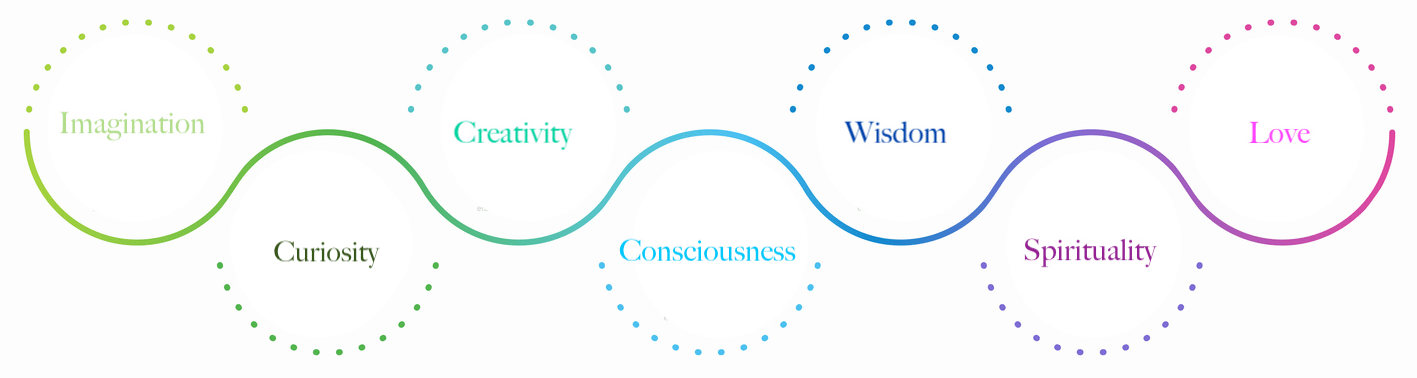
This unfolds through The Seven Transpersonal Stages:
Part 1 - Building the Inner World
1. Imagination
Applied Consciousness begins here.
Awareness becomes active, allowing the individual to move beyond immediate perception and explore possibilities, images, and meanings through daydreaming and symbolic thought.Consciousness shifts from passive awareness → creative engagement
2. Curiosity
Applied Consciousness becomes directional.
The individual is drawn to explore, question, and investigate what imagination has opened up.
Consciousness moves from possibility → active exploration
3. Creativity
Applied Consciousness becomes expressive.
Inner insights, ideas, and visions are externalised into form - through action, creation, or communication.
Consciousness moves from exploration → manifestation
Part 2: Crossing the Threshold
4. Expanded Consciousness
Applied Consciousness becomes experiential and transformative.
The individual accesses states beyond habitual perception, opening to deeper awareness, altered states, and transpersonal experience.
Consciousness moves from expression → expansion
This stage is pivotal.
It is where ordinary models of reality can loosen, dissolve, or reorganise.
From one perspective, this may be explained through changes in brain dynamics.
From another, it may feel like contact with something beyond the self.
Applied Consciousness does not force a conclusion.
Instead, it asks:
How are these experiences integrated?
Part 3: Integration and Transformation
5. Wisdom
Applied Consciousness becomes integrative.
Experiences and insights are processed, stabilised, and translated into meaningful understanding and guidance.
Consciousness moves from expansion → integration
6. Spirituality
Applied Consciousness becomes transpersonal.
The individual moves beyond the ego, experiencing connection, purpose, and alignment with something greater than the self.
Consciousness moves from integration → unity
7. Love
Applied Consciousness becomes embodied and relational.
All prior stages are unified into a lived expression of compassion, interconnectedness, and meaningful contribution.
Consciousness moves from unity → full embodiment
A Missing Layer: The Electric Brain and Body
Alongside this developmental model, another line of inquiry becomes relevant.
Neuroscience increasingly shows that:
the brain generates electromagnetic activity
the body is electrically integrated
organisms respond to environmental fields
This opens a subtle but important question:
Are our models entirely internal - or are they dynamically embedded in a wider system?
Rather than making strong metaphysical claims, we can take a grounded position:
Consciousness may be mediated through biological systems that both generate and respond to dynamic fields.
This perspective:
preserves scientific integrity
avoids reductionism
remains open to transpersonal experience
And it aligns naturally with Stage 4, where:
perception becomes less fixed
boundaries may soften
new forms of experience emerge
From Explanation to Integration
What distinguishes Applied Consciousness is not that it rejects existing theories.
It is that it repositions them.
Predictive processing helps explain how experience is structured
Neuroscience helps explain how states shift
Philosophy helps clarify assumptions
But none of these alone tell us:
how to live through these experiences
Applied Consciousness focuses on:
how expanded states become wisdom
how insight becomes embodied understanding
how awareness becomes relational and ethical
how development culminates in love as a way of being
Where This Leaves Us
If the field is to move forward, it may need to shift from:
defining consciousness
todeveloping consciousness
From:
explaining experience
tointegrating experience
From:
abstract debate
toapplied transformation
Final Thought
We may never fully resolve the metaphysics of consciousness.
But we can learn how to engage it.
And in doing so, something interesting happens:
imagination opens possibility
curiosity drives exploration
experience expands perception
wisdom grounds insight
and love integrates it all
Perhaps the real question is not:
What is consciousness?
But:
What does a fully developed consciousness look like in a human life?
That is the question Applied Consciousness begins to answer -
not by defining consciousness, but by developing it.
If you’d like to explore this work further, you can find more at:
https://www.britishtranspersonalassociation.org
Additional Information:
The Seven Transpersonal Stages integrates insights from neuroscience, cognitive science, psychology, philosophy, Transpersonal Psychology, and spiritual traditions.
Supporting theories:
Stage 1 - Imagination (Applied Consciousness in Action)
Iain McGilchrist – Right hemisphere theory
Carl Jung – Active imagination
Mark Johnson - Imagination as embodied meaning-making (not fantasy, but cognition itself)
Evan Thompson - Imagination as enactive and world-involving, not internal simulation
Shaun Gallagher - The narrative and embodied self - imagination as structuring experience
Stage 2 - Curiosity (The Drive to Explore Beyond the Known)
Abraham Maslow - Self-actualisation
Jean Piaget - Cognitive development
Alison Gopnik - Children as natural scientists driven by curiosity
Karl Friston - Curiosity as minimising uncertainty / free energy
Andy Clark- The brain as a prediction engine driven to explore
Stage 3 - Creativity (Transforming Inner Vision into External Reality)
Mihaly Csikszentmihalyi - Flow theory
Carl Jung - Creative individuation
Margaret Boden - Types of creativity (combinational, exploratory, transformational)
Anna Abraham - Neural basis of imagination + creativity
Keith Sawyer - Creativity as emergent and collaborative (not just individual)
Stage 4 - Expanded Consciousness (Accessing Deeper Dimensions of Experience)
Stanislav Grof - Holotropic states
Ken Wilber - Integral consciousness
Robin Carhart-Harris - Entropic brain theory, psychedelics, ego dissolution
Anil Seth - Controlled hallucination / predictive perception
Judson Brewer - Default Mode Network + meditation
Roland Griffiths - Mystical experience research (psilocybin)
Stage 5 - Wisdom & Truth (The Integration of Knowledge and Experience)
Eastern wisdom traditions
Iain McGilchrist - Right hemisphere mastery
John Vervaeke - Wisdom as relevance realisation
Igor Grossmann - Empirical study of wise reasoning
Martha Nussbaum - Integration of emotion, ethics, and reasoning
Stage 6 - Spirituality (A Movement Beyond the Self Toward Unity)
Carl Jung - Individuation
Vedanta and non-dual awareness traditions
David Loy - Non-duality and the illusion of the separate self
Rupert Spira - Direct experience of awareness as primary
Ann Taves - Study of non-ordinary and spiritual experiences without dogma
Stage 7 – Love (The Ultimate Integration of All Aspects of Being)
Agape (Christian mysticism)
Bhakti (Hindu devotional tradition)
Ken Wilber – Non-duality
Barbara Fredrickson - Love as micro-moments of connection
Stephen Porges - Polyvagal theory, safety, connection, compassion
Erich Fromm - Love as a practice and discipline